Spiral Similarity. Part II
The Appearance of Cyclists
In the previous story, we established a very important statement: if we want to map segment \(AB\) (red) to segment \(A'B'\) (blue) by spiral similarity (point \(A\) goes to \(A'\), and \(B\) goes to \(B'\)), we can do the following, for example. Find the intersection point \(Y\) of lines \(AA'\) and \(BB'\), then find the second intersection point \(Z\) of the circumcircles of triangles \(ABY\) and \(A'B'Y\), and point \(Z\) will be the center of the desired spiral similarity. (As an alternative, by virtue of the statement about Miquel’s point, we could look for the intersection point \(X\) of lines \(AB\) and \(A'B'\) and intersect the circles \(AA'X\) and \(BB'X\), but we will be interested in the first method.)
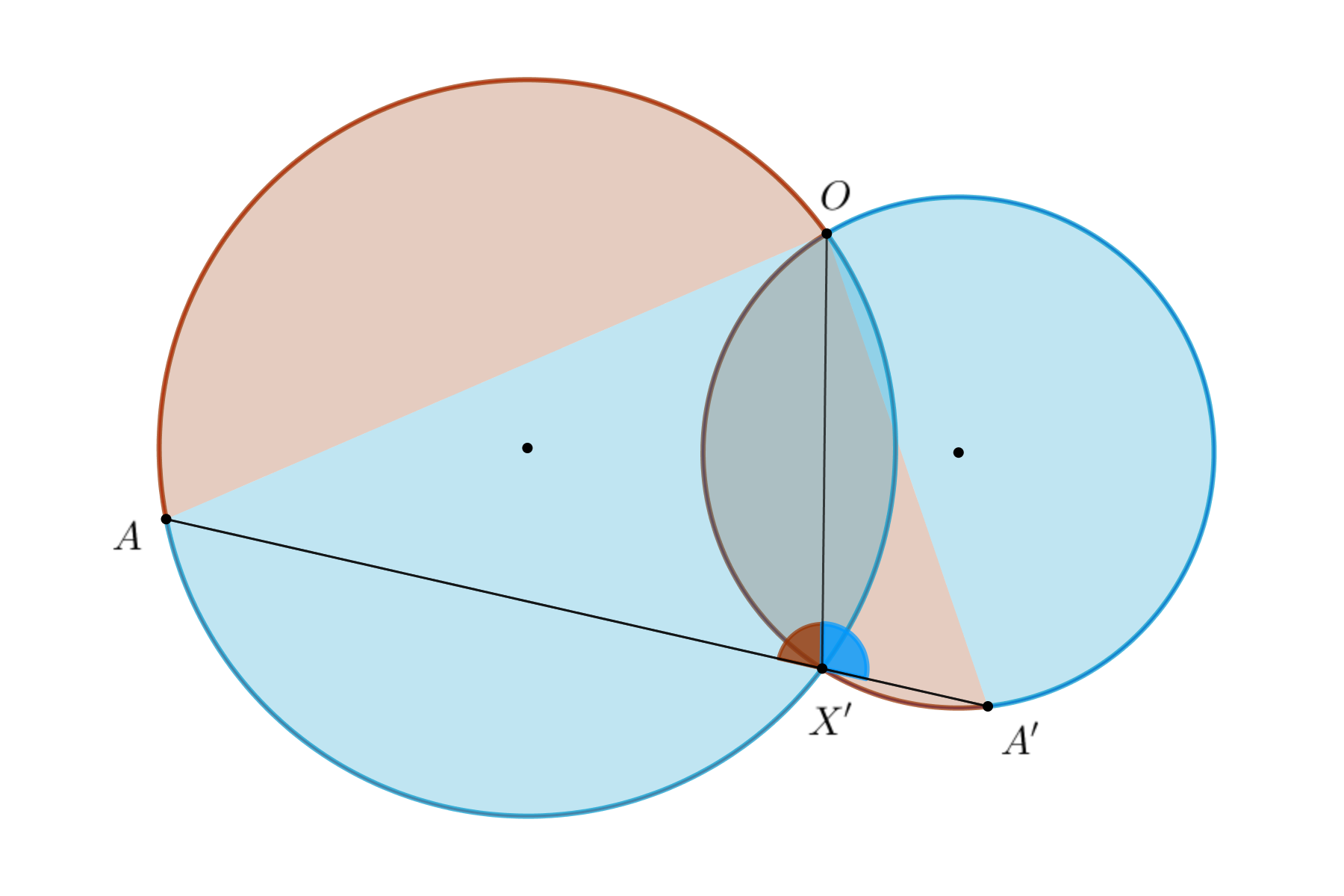
We see that in fact the obtained spiral similarity maps not just segments \(AB\) and \(A'B'\), but entire circles, the circumcircles of triangles \(OAB\) and \(OA'B'\), and \(O\) is a fixed point, and points \(C\) and \(C'\) are mapped if and only if \(CC'\) pass through \(X'\).
This statement can be interpreted as follows. If we launch two cyclists counterclockwise along the circles from point \(O\) with the same angular velocities, then the line c onnecting them will necessarily pass through the second intersection point \(X'\) of the circles.
Of course, this statement can be easily established by calculating angles, looking closely at the picture:
Many Similar Triangles
If \(O\) is the center of spiral similarity mapping segment \(AB\) to segment \(A'B'\), then it is also the center of spiral similarity mapping segment \(AA'\) to segment \(BB'\), in particular, triangles \(OAA'\) and \(OBB'\) are similar. Or, invoking the cyclists, we can conclude that all triangles, one of whose vertices is at point \(O\), and the other two in the synchronous position of the cyclists, are pairwise similar. We can also perceive this as: all angles \(\angle AOA'\) are the same (the angle of spiral similarity) and all ratios \(\frac{OA'}{OA}\) are the same (the coefficient of spiral similarity). In particular, this means that all triangles of the form \(OAA'\) are not just similar to each other, but also similar to triangle \(OZZ'\), where \(Z\) is the center of the circle along which the first cyclist rides, and \(Z'\) is the center of the trajectory of the second cyclist.
Trajectories of Corresponding Points
Now it is more or less clear how the loci of corresponding points in triangles \(OAA'\) will be arranged. If we choose some point, say, the incenter, then it must move along a circle passing through \(O\), and the center of this circle must, of course, be the incenter of triangle \(OZZ'\). All this is related to the fact that spiral similarity with center at point \(O\) mapping two positions of cyclists \(A\), \(A'\) to \(B\), \(B'\) also maps all corresponding points.
Trajectory of the Midpoint Between Cyclists
We have approached the most interesting part. Let us trace the trajectory of the midpoint of the segment connecting the cyclists. From the observations made, it follows that the midpoint \(M\) of segment \(AA'\) moves along a circle passing through point \(O\). The center of this circle is nothing other than the midpoint of segment \(ZZ'\). It is clear that then this circle, in particular, passes through the second intersection point \(X'\) of the original circles.
The Cyclist Lemma
The statement that is named the cyclist lemma consists in the fact that there is a point on the plane that is always equidistant from the cyclists. This is equivalent to the fact that the perpendicular bisectors to segments \(AA'\) always pass through one point. This is obvious — they pass through point \(V\), diametrically opposite to point \(X'\) in the circle constructed above, which is the locus of points \(M\).
This point can be defined differently from the construction: the point symmetric to point \(X'\) with respect to the midpoint of segment \(ZZ'\), that is, quadrilateral \(X'Z'VZ\) must be a parallelogram, and \(OVZZ'\) must be an isosceles trapezoid. In particular, angle \(\angle VOX'\) turns out to be right.