Spiral Similarity. Part I
What is spiral similarity?
Spiral similarity is, as the name suggests, a composition of rotation and homothety. It is convenient to view this from the perspective of vectors in the plane: under rotation, all vectors rotate by the same angle, and under homothety, they are stretched by the same factor. Under spiral similarity, all vectors are rotated and stretched, with both the rotation angle and the stretching factor being the same for all vectors. This, in particular, means that spiral similarity maps figures to similar figures, lines to lines, circles to circles, preserving all proportions in the process.
It turns out that spiral similarity (if it is non-trivial, i.e., the rotation angle is not a multiple of \(360^\circ\) and the stretching factor is not equal to 1) necessarily has a fixed point, called the center of spiral similarity. The center can be easily constructed from any point \(A\) and its image \(A'\) — it suffices to find a point \(O\) such that angle \(AOA'\) equals the rotation angle, and the ratio \(A'O/AO\) equals the stretching factor.
Note that the stretching factor in spiral similarity can be negative (as in ordinary homothety), but this can be easily avoided by adding \(180^\circ\) to the rotation angle if necessary (rotation by a straight angle is central symmetry). The composition of spiral similarities, by definition, is almost always a spiral similarity. The only exceptions are those cases when the sum of rotation angles is a multiple of \(360^\circ\) and the product of the factors equals 1. In this case, all vectors preserve their directions and lengths as a result of the composition, i.e., the composition is a translation.
How to map two segments by spiral similarity?
Suppose we are given two segments \(AB\) and \(A'B'\) in the plane and we want to map them by spiral similarity so that point \(A\) goes to point \(A'\), and point \(B\) goes to point \(B'\). Can this always be done? Is it unique? How to find the center of the corresponding spiral similarity?
There are a couple of trivial cases. If the segments are equal and parallel, then, of course, they cannot be mapped by spiral similarity — the role of the needed spiral similarity in this case is played by translation. If the segments are parallel but not equal, then obviously we can use an ordinary homothety with center at point \(O\), the intersection of lines \(AA'\) and \(BB'\) (triangles \(OAB\) and \(OA'B'\) in this configuration are similar due to the parallelism of lines \(AB\) and \(A'B'\)).
Let us now turn to the general case. Suppose segments \(AB\) and \(A'B'\) are not parallel, then it is easy to determine the angle of spiral similarity — it is exactly equal to the angle between the segments (here it would be correct to speak of a “directed angle”). That is, if lines \(AB\) and \(A'B'\) intersect at point \(X\), then the center \(O\) of spiral similarity must satisfy the equalities \[ \angle AOA'=\angle BOB'=\angle AXA'=\angle BXB'. \] Again, the equality should be understood as equality of directed angles. This means that the center of spiral similarity must lie simultaneously on the circumcircles of triangles \(AXA'\) and \(BXB'\). One intersection point of the circles is point \(X\). It is suitable as a center only in the case of similarity of triangles \(XAA'\) and \(XBB'\), i.e., in the case of parallelism of lines \(AA'\) and \(BB'\) and tangency of the circumcircles of triangles \(AXA'\) and \(BXB'\), i.e., essentially when the second intersection point \(O\) coincides with point \(X\).
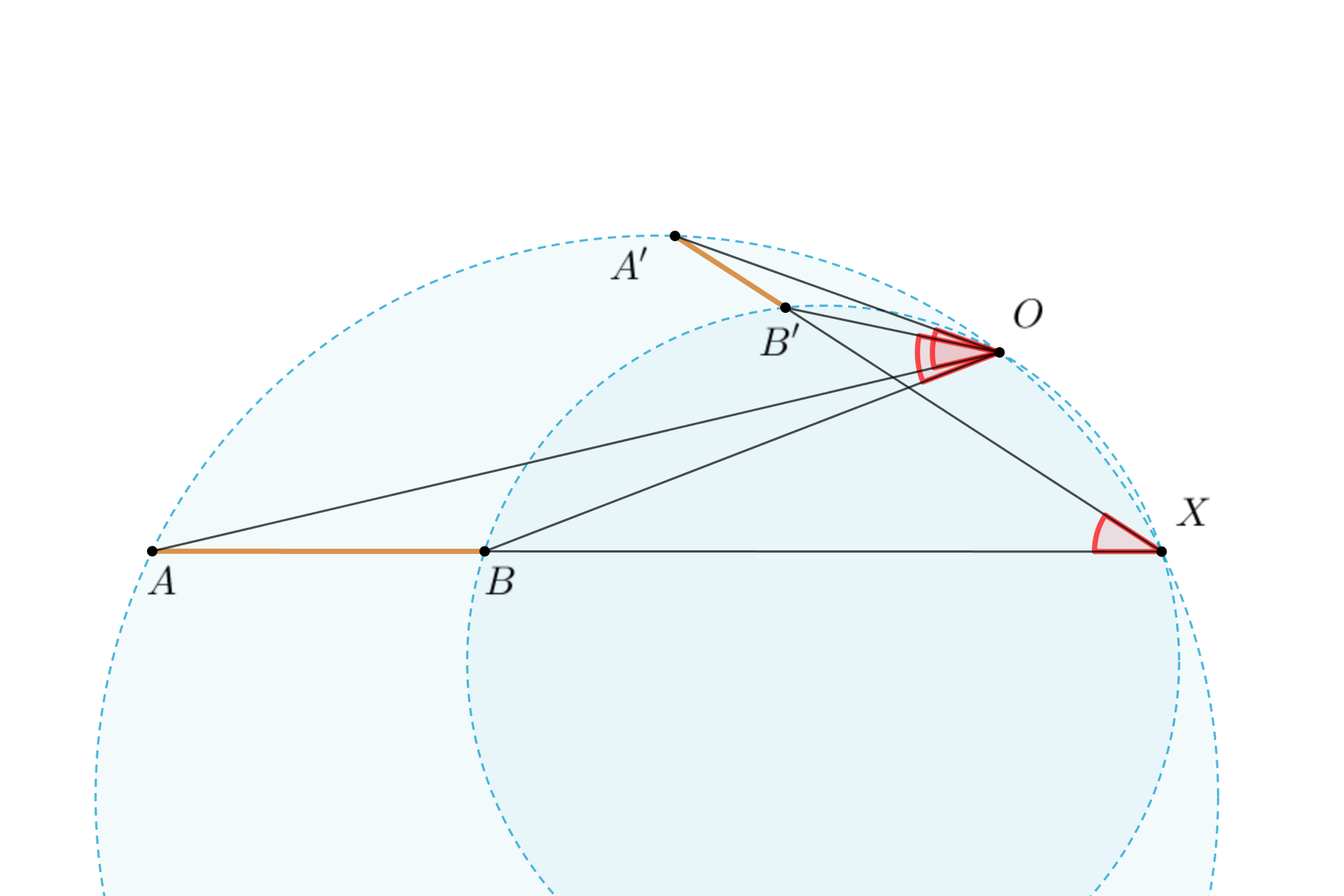
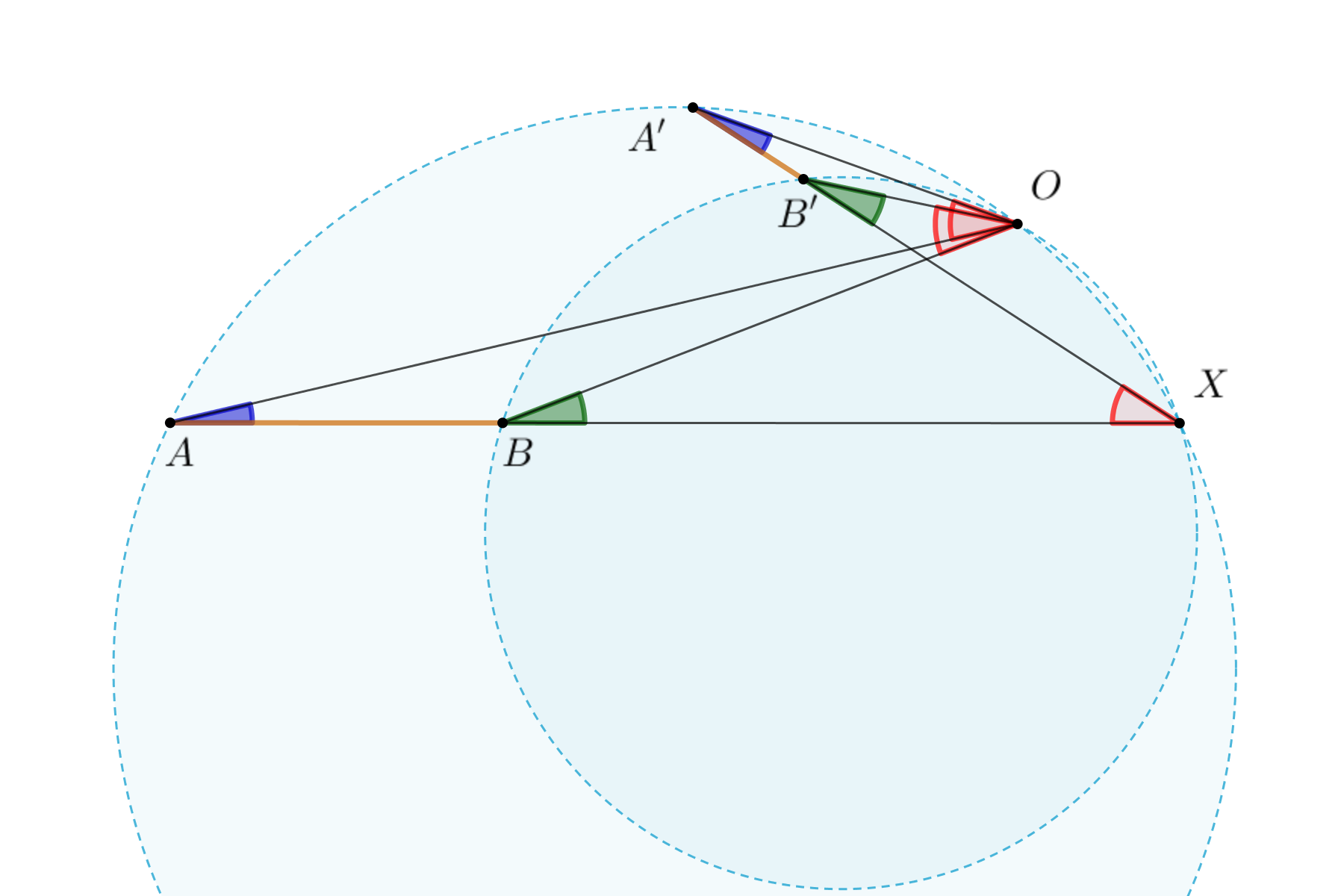
The center of spiral similarity is found, it always exists, except in degenerate cases, is unique, and can be found as the intersection point of two circles. Cool!
An important observation and Miquel’s point
The most striking and simple observation that can be made is that if \(O\) is the center of spiral similarity mapping segment \(AB\) to segment \(A'B'\), then point \(O\) is also the center of spiral similarity mapping segment \(AA'\) to s egment \(BB'\). Indeed, from the similarity of triangles \(OAB\) and \(OA'B'\), it is easy to derive the similarity of triangles \(OAA'\) and \(OBB'\), by comparing angles and ratios of segments with vertex \(O\).
But we know how to construct the center of spiral similarity mapping segment \(AA'\) to segment \(BB'\) in the case when they are not parallel — we need to intersect lines \(AA'\) and \(BB'\) at point \(X'\), and the second intersection point of the circumcircles of triangles \(ABX'\) and \(A'B'X'\) will be the center of spiral similarity.
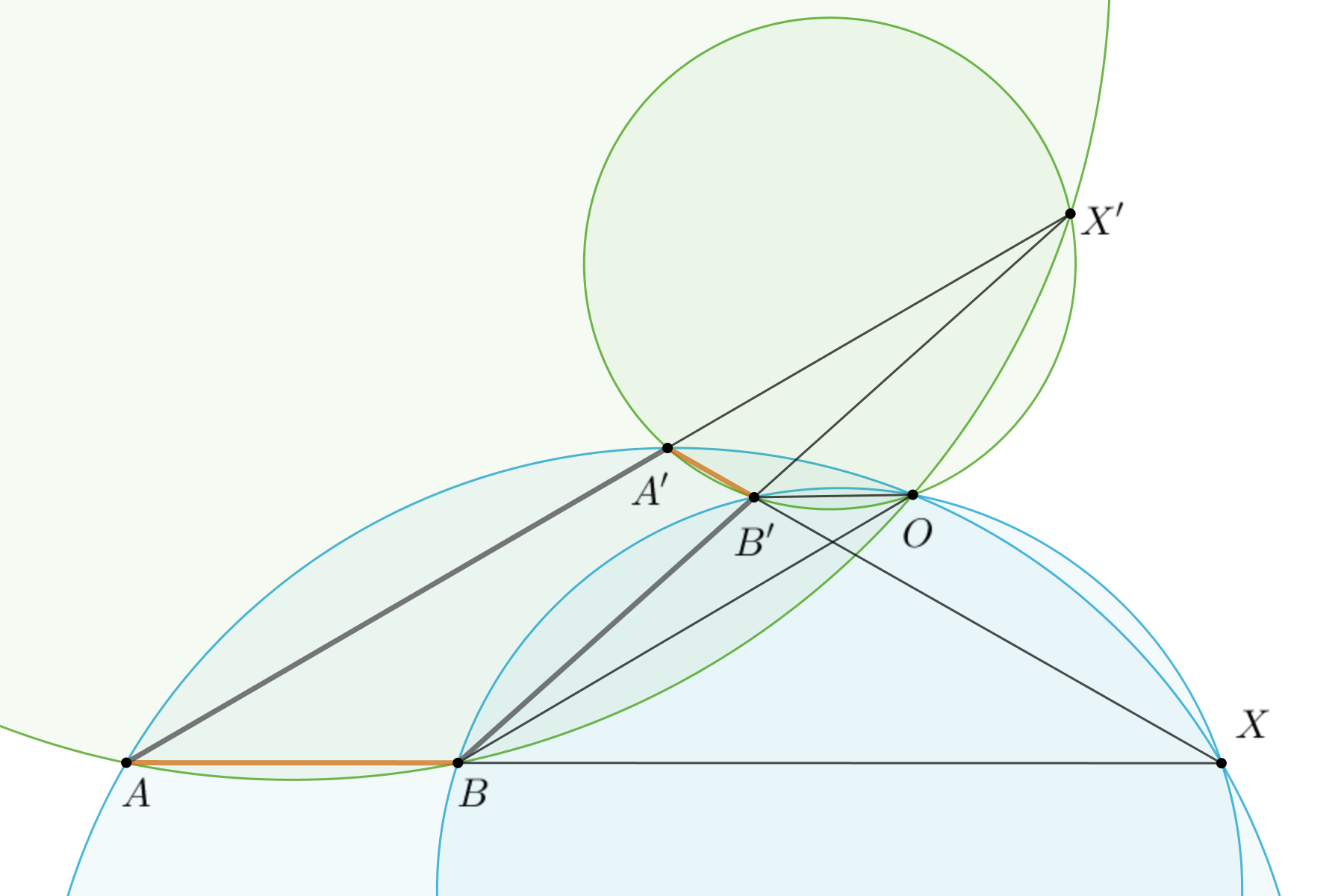
What conclusion can we draw? Four circles pass through one point: the circumcircles of triangles \(AA'X\), \(BB'X\), \(ABX'\), and \(A'B'X'\). This statement can be formulated as follows.
Miquel’s Point.
For any four lines, the circumcircles of the four triangles formed by them intersect at one point. This point is called Miquel’s point of the four lines.
We will not discuss Miquel’s point in detail in this article. I will only note that this is a very powerful statement that, with proper skill and correct perception, allows one to see much immediately in the geometric picture in various problems. If you have never seen this statement, try using it to prove the fact about Simson’s line: the feet of perpendiculars from point \(P\) to the sides of triangle \(ABC\) lie on one line if and only if point \(P\) lies on the circumcircle of triangle \(ABC\).