An elementary proof of Feuerbach’s theorem
Let us begin with the statement of Feuerbach’s theorem.
Feuerbach’s theorem.
For any scalene triangle, the nine-point circle is tangent to the incircle.
How do you prove tangency?
Problems about tangent circles often share the same pattern: you must prove tangency, but the point of tangency does not appear in the statement. The first step is usually not computational but heuristic — you need to guess where exactly the two circles should touch. Once the right point is found, what often remains is an angle chase.
That is why points with rich “cyclic structure” are so useful. A typical example is the Miquel point: many circles pass through it, so it automatically supplies a large number of angle equalities. Feuerbach’s theorem, however, admits a slightly different convenient route. Instead of guessing the future point of tangency right away, we first look for an auxiliary point tied simultaneously to the incircle and to the nine-point circle.
Let triangle \(ABC\) have incenter \(I\), and let the incircle touch the sides \(BC\), \(CA\), and \(AB\) at \(D\), \(E\), and \(F\), respectively. Write \(M\), \(N\), and \(K\) for the midpoints of the corresponding sides, and denote the nine-point circle and the incircle by \(\Omega\) and \(\omega\), respectively.
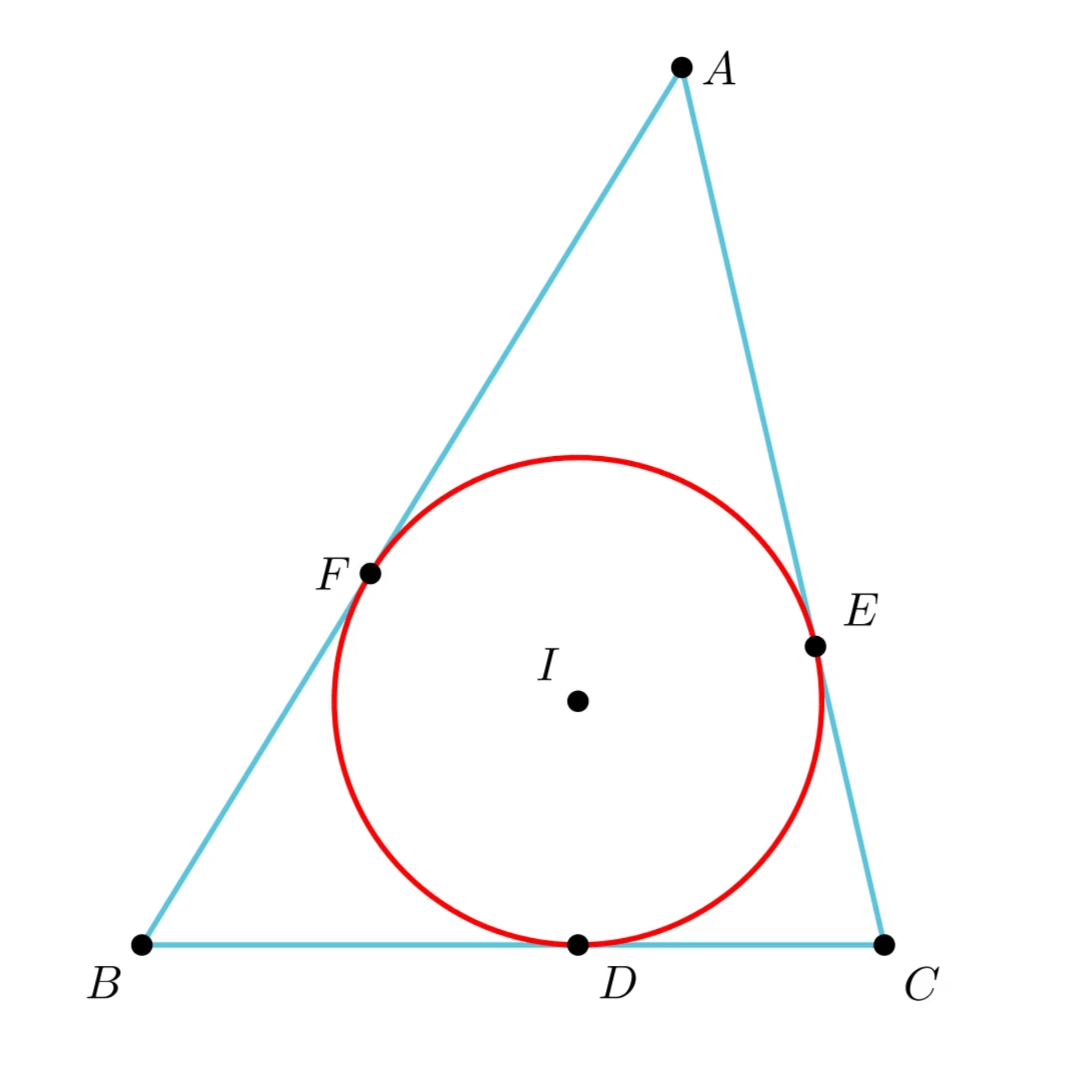
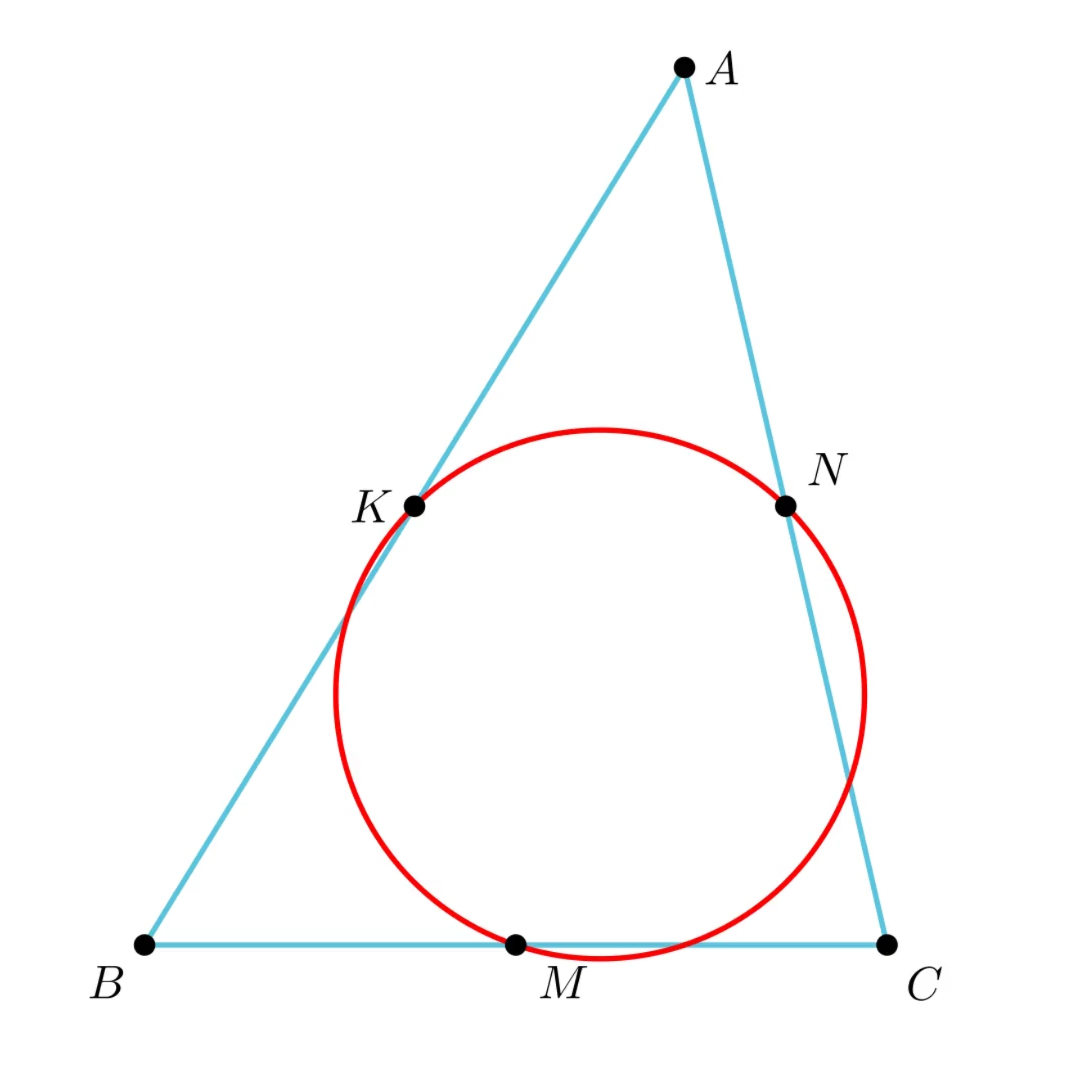
How might one guess such an auxiliary point? The figure already shows several midpoints, so it is natural to try adding one more midpoint. It turns out that the midpoint \(J\) of segment \(AI\) is an excellent choice: it reveals a wealth of structure in the configuration.
Why is the point \(J\) so useful?
First, \(J\) is the incenter of triangle \(ANK\). Indeed, triangle \(ANK\) is homothetic to triangle \(ABC\) with center \(A\) and ratio \(1/2\): vertex \(B\) goes to \(K\), and \(C\) goes to \(N\). Thus \(J\) is the image of \(I\) and therefore is the incenter of triangle \(ANK\).
Second, \(J\) is the circumcenter of cyclic quadrilateral \(AEIF\), because triangles \(AEI\) and \(AFI\) are right and share hypotenuse \(AI\).
Consider two natural auxiliary circles: \[ \omega_1 = (JNE), \qquad \omega_2 = (JKF). \] Let \(\Phi \neq J\) be their second intersection point. We will show that this is precisely the point where the nine-point circle and the incircle touch — the Feuerbach point.
For simplicity we assume that side \(BC\) is the shortest; then the order of points on the sides matches our figures. In the general case one may argue using directed angles.
The point \(\Phi\) lies on the incircle
Using the cyclic quadrilaterals \(JNE\Phi\) and \(JKF\Phi\), we obtain \[ \angle F\Phi E=\angle F\Phi J+\angle J\Phi E=\angle JKA+\angle JNA=\frac{\beta}{2}+\frac{\gamma}{2}=\angle FDI+\angle EDI=\angle FDE, \] which proves that \(\Phi\in \omega\).
The point \(\Phi\) lies on the nine-point circle
Again using the same cyclic quadrilaterals, \[ \angle N\Phi K=\angle N\Phi J+\angle J\Phi K=\angle AEJ+\angle JFA=\frac{\alpha}{2}+\frac{\alpha}{2}=\angle NMK, \] so \(\Phi\in \Omega\).
Why are the circles tangent at \(\Phi\)?
We have shown that \(\Phi\) lies on both the incircle and the nine-point circle. It remains to prove that these circles share the same tangent line at \(\Phi\). This can be expressed in terms of angles in triangles \(\Phi KN\) and \(\Phi FE\); concretely, we need the identity
\[ \angle K\Phi F=\angle KN\Phi - \angle FE\Phi. \]
In this equality we can eliminate \(\Phi\) by moving all angles to the point \(J\). For the right-hand side we argue as follows. Since \(\angle JN\Phi=\angle JE\Phi\), the difference on the right becomes \[ \angle JNK + \angle KN\Phi = \angle JEF + \angle FE\Phi \,\, \Rightarrow \,\, \angle KN\Phi - \angle FE\Phi = \angle JEF- \angle JNK. \]
The angle on the left-hand side is simply \(\angle KJF\). Thus it suffices to verify that \[ \angle KJF=\angle JEF- \angle JNK. \]
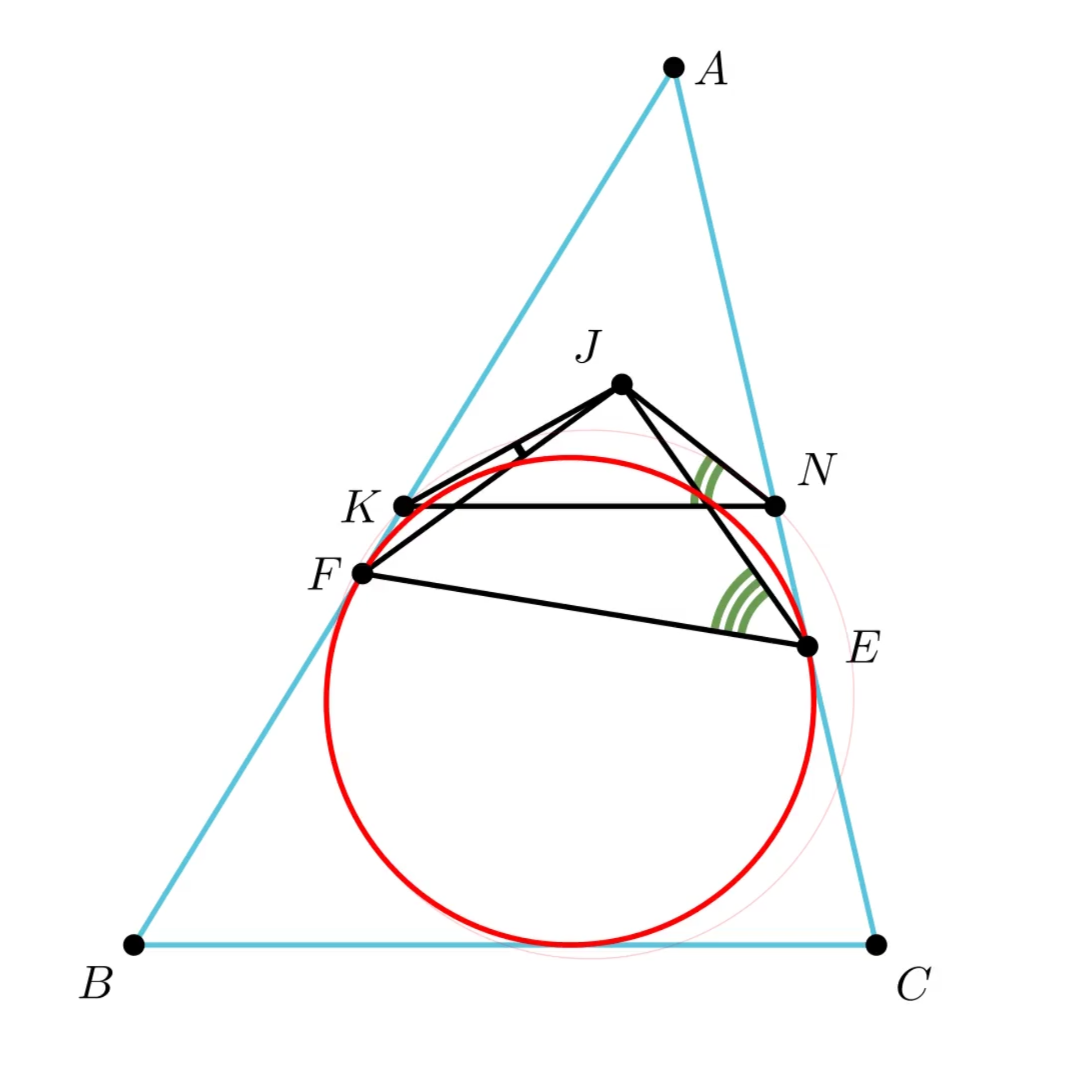
All three angles in this identity can be expressed through the angles of triangle \(ABC\):
since \(J\) is the circumcenter of triangle \(AEF\):
\[ \angle JEF = 90^\circ-\alpha; \]
since \(J\) is the incenter of triangle \(AKN\):
\[ \angle JNK= \frac{\gamma}{2}; \]
similar observations yield the equality:
\[ \angle KJF=\angle AJF-\angle AJK= (180^\circ-\alpha) - (90^\circ+\frac{\gamma}{2})=\angle JEF - \angle JNK. \]
Note that the last proved identity is equivalent to the circles \((JKN)\) and \((JFE)\) being tangent at \(J\).
In place of a conclusion
The whole proof hinges on one well-chosen point — the midpoint \(J\) of segment \(AI\). At first glance it is just “one more midpoint” in a picture that already has plenty of them. Yet it is exactly there that the two main geometric threads of the theorem meet: the geometry of the incircle and the geometry of the nine-point circle, which leads to an elegant and elementary proof.